At 22, heavily expectant and determined to complete her CPA qualification, Dr. Toseef Din Msc,FCCA, CPA(K),Bsc climbed four flights of stairs to attend an evening class. When she entered the packed classroom, there were no seats left. No one stood up for her, so she remained standing throughout the 90-minute lesson.
“That day, I pledged to myself that I would stand up and create spaces for women.”
Years later, now Chief Executive Officer of M.P. Shah Hospital and a Board Member of Global Compact Network Kenya, Dr. Din shared that defining experience as she delivered the keynote address at the launch of the 2026 Target Gender Equality Accelerator Kenya cohort.
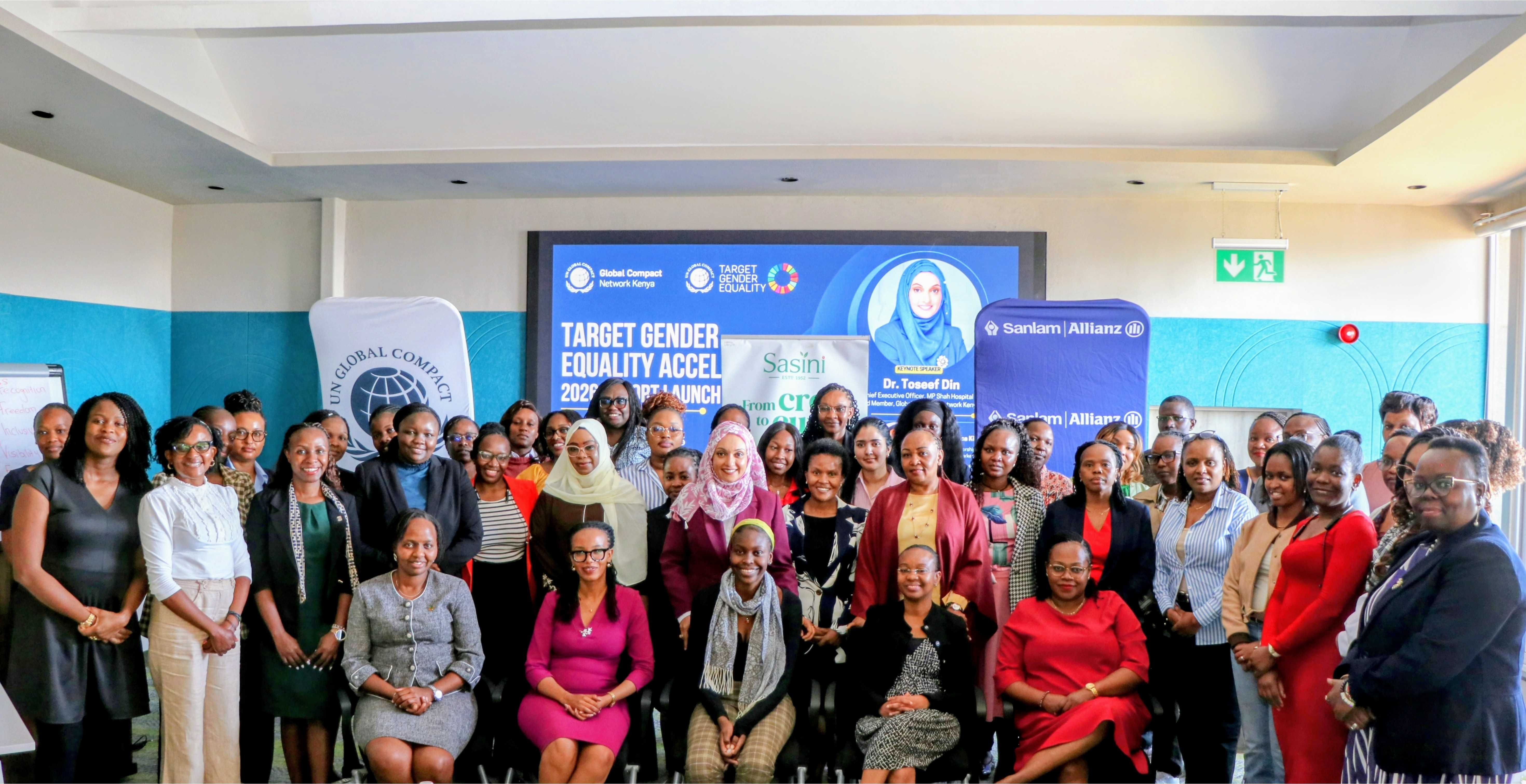
Held on 13 August 2026 in Nairobi, the launch brought together representatives from 19 companies across different sectors and organizational sizes. It marked the beginning of a six-month journey designed to help companies move beyond commitments and take practical, measurable action to advance gender equality.
Participants began the morning by sharing what gender equality in the workplace meant to them. Their responses included access, safety, opportunity, empowerment, growth, representation, equity, fairness, visibility, inclusivity, recognition, freedom, impact, and progress. Together, the words reflected the workplaces companies are being challenged to build, places where people are supported to participate, contribute, lead, and thrive.
Programme sponsors SASINI PLC and SanlamAllianz Kenya Allianz reinforced why this work must be treated as a business priority.
Carol Mutuku, Deputy General Manager at Sasini Fruits and Nuts EPZ, shared Sasini’s commitment to achieving equal representation of women and men in leadership. Women accounted for 42.8% of management positions in 2025, against the company’s 50:50 ambition. She emphasized that ambitious targets are only a starting point, and that real progress requires leadership ownership, measurement, transparency, and accountability.
Scholastica Kiboro , Head of Partnerships, Growth and Marketing at Sanlam Allianz Life Insurance (Kenya) Limited, reflected on the company’s experience as a signatory to the Women’s Empowerment Principles (WEPs). While Sanlam Allianz has achieved equal representation at overall workforce level, women’s representation narrows higher up the leadership ladder, standing at 44% at supervisory level, 41% at executive and senior management level, and 33% at Board level. Her point was direct: intention without mechanisms produces very little. Organizations must build the structures, sponsorship, succession pathways, mentorship, and accountability that enable women to progress.
A KEYNOTE GROUNDED IN LEADERSHIP AND LIVED EXPERIENCE
Dr. Din’s keynote brought those numbers back to the people behind them.
She distinguished between gender equality and gender equity through a simple analogy: gender equality gives everyone shoes, while gender equity ensures that the shoes fit. Fairness, she noted, is not achieved by offering everyone the same thing, but by understanding and addressing the different barriers people face.
Drawing from her own leadership journey, Dr. Din shared that women now comprise 64% of the workforce at M.P. Shah Hospital, 83% of senior management, 78% of junior management, and 100% of nurse managers. Two women also now serve on the hospital’s Board.
These outcomes have not been accidental. They have required deliberate action. Among the measures introduced at the hospital is a rotational acting CEO programme, through which members of the senior leadership team assume the CEO’s responsibilities whenever Dr. Din is away. The hospital has also invested in mentorship and succession planning and taken an intentional approach to ensuring women are considered for roles in traditionally male-dominated fields.
“Strong leaders do not simply build successful organizations. They build other leaders.”
Dr. Din challenged companies to stop treating gender equality as the sole responsibility of human resources, sustainability, or diversity teams. It must be owned visibly by Boards, chief executives, and senior management, and integrated across recruitment, remuneration, procurement, product design, marketing, risk management, and community engagement.
She encouraged the incoming cohort to be honest about their starting point, set clear and measurable goals, involve the entire organization, and sustain the work beyond the accelerator. Above all, she called for compassionate leadership that remembers the person behind every policy, statistic, and organizational decision.
Her keynote ended with the room on its feet, united in one declaration: “I stand up for gender equality.”
MOVING FROM COMMITMENT TO MEASURABLE CHANGE
The Target Gender Equality Accelerator is a global programme of the United Nations Global Compact, delivered in collaboration with UN Women. Through the UN Global Compact Academy, the Women’s Empowerment Principles (WEPs) Gender Gap Analysis Tool, peer learning, and action planning, participating companies will assess where they are, identify their most significant gaps, and develop practical pathways for progress.
The six-month programme combines global learning with locally grounded conversations, allowing participating companies to apply gender equality principles within the realities of the Kenyan business environment. Company representatives will lead the day-to-day work, supported by senior-level ambassadors who will help embed the learning within leadership discussions, policies, and organizational culture.
The launch also drew on the experiences of companies that have already completed the accelerator.
Moderated by Lorraine Kithinji CHRP (K), Project Coordinator at Global Compact Network Kenya, the panel featured Margaret Njoki Kariuki-MBA, SBS HBS online, CRMA®, CIA®, CPA, Head of Sustainability at Sanlam Allianz Life Insurance (Kenya) Limited; Christine Wakenyi - CCBM, Payroll and Compensation Benefits Manager at Sasini Plc; Vivian Dabani YIPP, ESG Lead at CIC Insurance Company; and Christine Nderimo, General Manager, Operations at Charleston Travel.
Their experiences showed that meaningful progress begins with an honest assessment of where an organization stands.
Christine Wakenyi shared how Sasini Plc’s initial score of 16% on the Women’s Empowerment Principles Gender Gap Analysis Tool became a wake-up call, particularly on leadership commitment. The company has since worked to embed gender equality within its sustainability strategy while recognizing that its different subsidiaries, crops, and communities require tailored interventions. Progress, she noted, will not always follow a straight line, but organizations must understand their numbers, acknowledge fluctuations, and keep improving.
Viviane Dabani described how CIC Insurance Group used the accelerator to move from broad commitments to a more structured and measurable approach. Its progress from the beginner level to the improver level demonstrated how small but intentional changes can translate into measurable results. The company is also extending its focus beyond the workforce by setting targets to increase procurement opportunities for women-owned businesses.
Margaret Kariuki shared that Sanlam Allianz’s assessment score had risen from 18% to 62%, supported by its public commitment to the Women’s Empowerment Principles, leadership ownership, employee engagement, and more deliberate collection of data across its workforce, customers, and community initiatives. She also emphasized the importance of engaging men as allies, noting that gender equality cannot be advanced through conversations involving women alone.
Christine Nderimo reflected on how Charleston Travel’s journey evolved from meeting sustainability requirements for international business opportunities to examining what gender equality should mean within its own organization. This has included confronting individual biases, strengthening leadership ownership, reviewing workplace policies, and beginning to track progress more systematically. She emphasized that meaningful change cannot be carried by one person or department, but must be understood and owned across the organization.
Across the different experiences, several lessons stood out: involve other departments early, understand and disaggregate organizational data, secure leadership support, make the work part of existing responsibilities and performance measures, and use the cohort as a network for honest peer learning.
Most importantly, companies were encouraged not to focus only on achieving a higher assessment score, but on the change that the score should represent.
FROM LEARNING TO ACTION
The launch concluded with Accelerator Support Clinics, where participating companies received practical guidance on navigating the UN Global Compact Academy, completing the Women’s Empowerment Principles Gender Gap Analysis Tool, developing their action plans, and meeting the programme’s technical requirements.
The launch marked an important beginning, but the real measure of success will be what happens next within the 19 participating companies: the conversations that reach leadership tables, the data that reveals previously unseen gaps, the policies that are reconsidered, the opportunities that are opened, and the people whose experiences at work begin to change.
Global Compact Network Kenya appreciates Sasini Plc and Sanlam Allianz for sponsoring the 2026 cohort, and all the business leaders, accelerator alumni, and participating companies who contributed to the launch.
The challenge now is to turn commitment into action, and action into lasting impact.