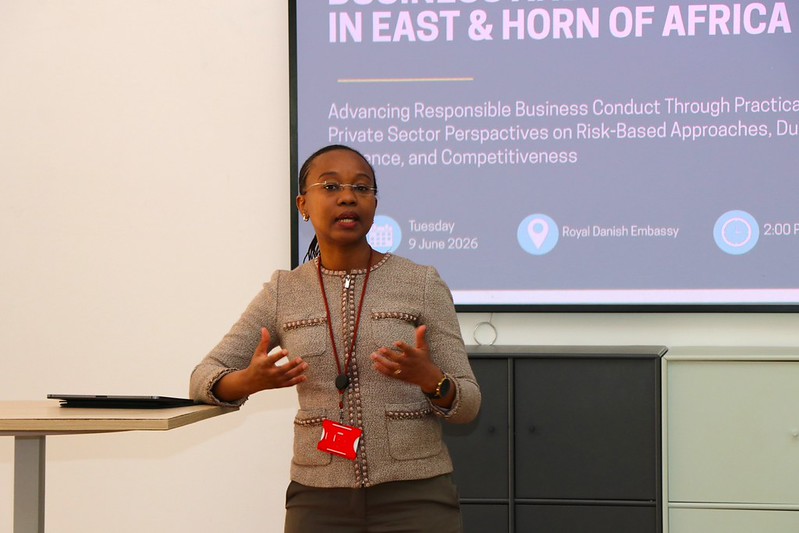
This afternoon, Global Compact Network Kenya joined the Ministry of Foreign Affairs of Denmark, Danish Industry and Folkekirkens Nødhjælp (DanChurchAid) in convening a private, closed‑door Pre‑Dialogue with business leaders ahead of the East and Horn of Africa Business and Human Rights Session taking place in Nairobi on 10–11 June. Hosted at the Royal Danish Embassy, the session brought together companies, government representatives, business member organisations and civil society to shape a strong, regionally grounded private sector voice that will feed directly into the two‑day dialogue.
Human rights and social sustainability as a foundation
Judy Njino, Executive Director, Global Compact Network Kenya, framed human rights and social sustainability not as a parallel CSR track, but as the organizing logic of how competitive businesses will be built in East Africa over the next decade. Drawing from the Network's work with businesses across sectors, she underlined that the most resilient enterprises are those treating human rights due diligence as a core management discipline – one that shapes strategy, product design, sourcing, workforce models and stakeholder engagement, rather than an add‑on driven by compliance.
She challenged participants to move the conversation beyond “why” to “how”, focusing on the quality of risk analysis, the sophistication of data and the credibility of remedy and engagement processes. Judy spoke to emerging pressure points, from value‑chain traceability and just transitions, to digital platform work and rising expectations from investors and buyers, and highlighted Global Compact Network Kenya as a partner that can help companies anticipate these trends, test solutions and turn responsible business conduct into a source of innovation, influence and market differentiation for Kenyan and regional firms.
Why business leadership on human rights matters now
In his opening remarks, Christian Staffeldt of the Royal Danish Embassy in Nairobi framed why business leadership on human rights in East Africa is more urgent than ever. He noted that East Africa and the Horn continue to attract significant international investment in sectors such as agribusiness, energy and infrastructure, all of which have deep interfaces with communities, labour conditions, land use and the environment. Christian stressed that global regulatory expectations – particularly in Europe around due diligence, sustainable finance and responsible sourcing – are evolving rapidly, and that responsible business conduct is now directly linked to competitiveness, market access, financing and long‑term resilience, rather than being viewed solely as a values‑driven or compliance issue.
The role of business membership organisations and social partners
Speaking from the perspective of business membership organisations, Klaus Lehn Christensen of Danish Industry East Africa reflected on the centrality of decent work and worker protections to sustainable competitiveness. He described how Danish Industry and partners work with business member organisations and trade unions to strengthen labour market institutions, build capacity on workers’ rights and help companies navigate new EU trade and sustainability requirements. Klaus emphasised that sustainability and human rights expectations are increasingly becoming a “global licence to operate”, with similar demands emerging in other major markets beyond the European Union, and that companies in the region need to prepare for this new normal if they are to fully benefit from trade agreements and investment flows.
From the civil society and development side, Roya A. Z. Høvsgaard of DanChurchAid explained DCA’s role as a dialogue partner and convener that bridges programme work and corporate responsibility. She spoke about the practical questions that businesses and civil society are grappling with, from where to start with due diligence, to how to conduct risk and impact assessments, and who to consult along the way. Roya highlighted the importance of supporting small and medium‑sized enterprises that may be indirectly affected by EU standards through export and supply‑chain relationships, and underscored that DanChurchAid sees itself as a partner in co‑creating solutions rather than an actor that simply calls businesses out.
A panel grounded in operational realities
A panel moderated by Stephen Kimenye, Program Manager at Global Compact Network Kenya, then explored operational realities, business implications and practical experiences of responsible business conduct from three complementary vantage points: government, corporate and value‑chain.
Government and national human rights institution perspective: Christina Arrumm, Senior Human Rights Officer at the Kenya National Commission on Human Rights (KNCHR), outlined priority human rights issues that businesses should be paying attention to today. These include land and large‑scale projects in agriculture, extractives and infrastructure; labour conditions and gaps in protections; risks in the largely unregulated gig and digital economy; gender‑based violence and harassment in workplaces; and the rights of migrants and refugees who are increasingly part of the workforce. She invited stronger private sector engagement in the ongoing review of Kenya’s National Action Plan on Business and Human Rights so that policy measures are grounded in business realities and enjoy shared ownership at implementation stage.
Corporate manufacturing perspective: From the corporate lens, Margaret Muchoki of Chloride Exide Limited shared concrete examples of how the company is investing in safer working conditions, environmental controls and community‑friendly operations across its manufacturing footprint. She discussed how measures such as installing industrial scrubbers to manage emissions and investing in employee health and safety programmes, while requiring significant upfront capital, have reduced downtime, prevented disputes, strengthened the company’s social licence and made commercial sense over time. Margaret also reflected on the practical challenge of tracing upstream supply chains for critical materials used in batteries and balancing responsible sourcing ambitions with cost and competitiveness pressures in a highly contested market.
Value‑chain and export‑oriented perspective: Trevor Rerimoi, Site Lead and Managing Director at Cimbria East Africa Ltd. brought in a value‑chain perspective from agricultural commodities and grain handling. He highlighted how global buyers and financiers are increasingly asking for evidence of traceability, social and environmental risk management, and due diligence across suppliers, and how this is reshaping expectations for companies operating in East African value chains. Trevor stressed that responsible business conduct is becoming integral to accessing markets and finance and called for continued collaboration with partners such as Global Compact Network Kenya, government and financial institutions to co‑develop practical tools, provide training and support value‑chain actors to meet emerging standards rather than simply passing risk down the chain.
Navigating new regulations and preparing for the Dialogue
The panel was followed by a presentation from Bianca Peters of Deutsche Gesellschaft für Internationale Zusammenarbeit (GIZ) GmbH on “Navigating Responsible Business Conduct: The EU CSDDD and the Business & Human Rights Navigator”. Bianca unpacked how the EU Corporate Sustainability Due Diligence Directive will set a new benchmark for integrating human rights and environmental due diligence into corporate governance and how its effects will cascade through global value chains. She underscored that companies that begin preparing early – by building systems for risk assessment, traceability and worker engagement – will be better positioned to remain competitive and maintain access to key markets as the regulatory landscape evolves.
In closing, participants broke into sector‑ and geography‑based roundtables to turn these insights into practical, risk‑based position statements on how knowledge sharing, due diligence and collaboration can advance responsible business conduct in their specific contexts. These statements will feed directly into the East and Horn of Africa Business and Human Rights Session taking place in Nairobi on 10–11 June, ensuring that the perspectives of businesses operating in and sourcing from East Africa are clearly articulated in the regional dialogue.
Across the different tables, participants converged on several core messages: due diligence offers businesses a rare, 360‑degree view of their operations and value chains, helping uncover efficiency gains, cost savings and reputation risks that are otherwise easy to miss; successful implementation will depend on localizing global standards to East African realities, calibrating expectations for different types of suppliers, and investing in the technical support and capacity building many companies and civil society organizations still need; and scaling responsible business conduct requires an ecosystem approach in which government, regulators, business associations, civil society and companies share the burden of costs, data and knowledge rather than acting in isolation. Associations and intermediary organizations were repeatedly cited as critical enablers – aggregating learning, spreading costs, and helping smaller firms meet rising expectations – while calls were made for smarter incentives, including tax and policy measures, to reward businesses that are proactively integrating human rights and environmental due diligence into their models.
As Global Compact Network Kenya, we are looking forward to carrying today’s insights into tomorrow’s discussions and continuing to support companies in turning commitments into concrete action – and action into impact for people, planet and business.