Ask a business leader whether their company supports gender equality and the answer will almost always be yes. Ask how they know their efforts are working, and the conversation becomes harder. That second question shaped every session at the Women’s Empowerment Principles (WEPs) Forum 2026, held on Wednesday, 4 November 2026 in Nairobi.
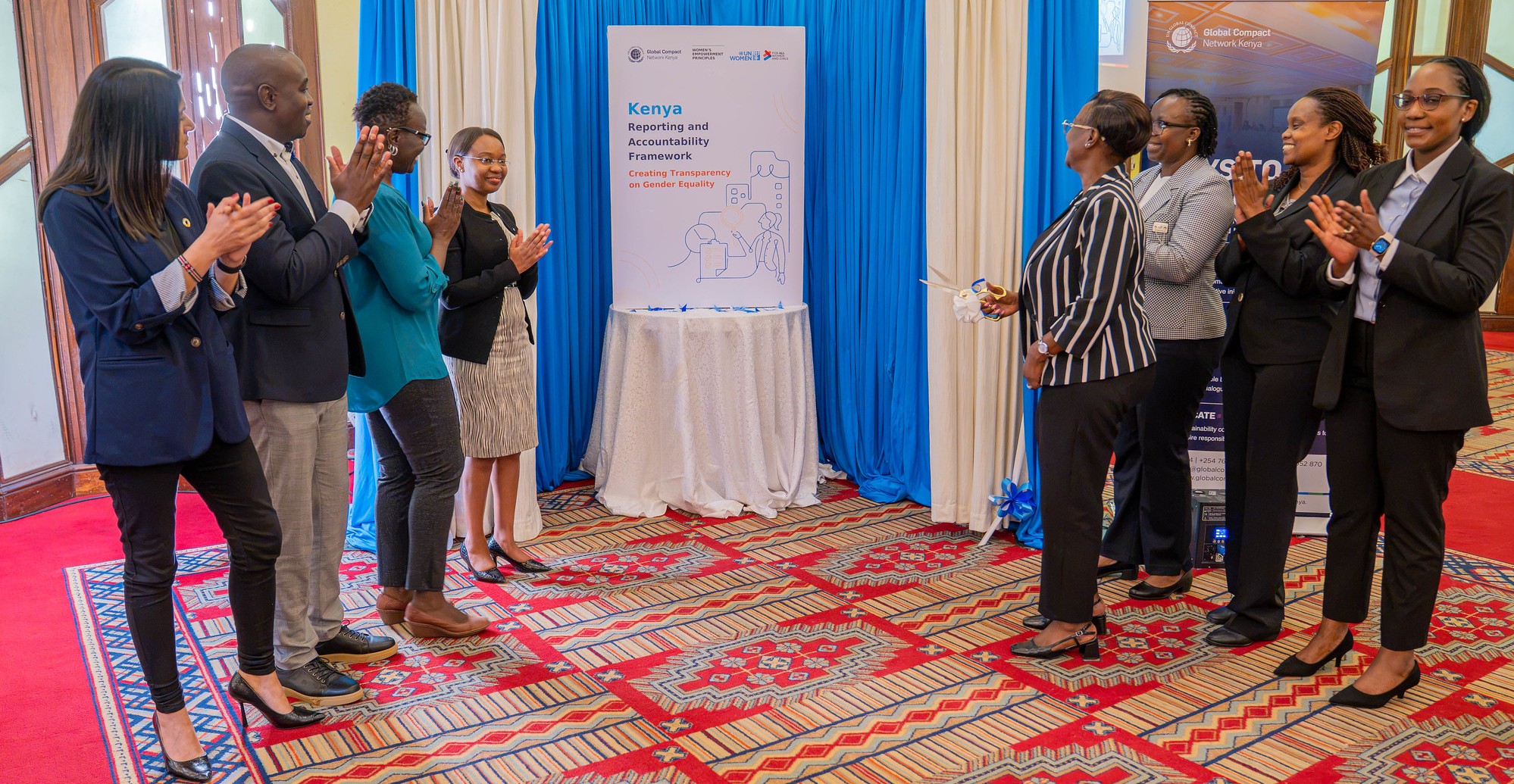
Convened by Global Compact Network Kenya (GCNK) in partnership with UN Women Kenya under the theme "From Commitment to Action: Measuring and Reporting Progress on Gender Equality and Women's Empowerment", the Forum brought together 200 participants from WEPs signatories to prospective signatories, development partners, government institutions and civil society organizations. At its center was the launch of the Kenya Reporting and Accountability Framework, the first tool of its kind in Kenya, designed to measure company progress against the seven Women’s Empowerment Principles.
The framework responds to a practical problem. Kenyan companies are running a wide range of gender equality initiatives, yet information on that progress sits scattered across annual reports, sustainability disclosures and individual programmes. There has been no consolidated picture of what WEPs signatories are achieving together, or where they need support. The Forum set out to change that through four stages: reflect, launch, exchange and commit.
What the data tells us
In her opening remarks, Ms Judy Njino, Executive Director, Global Compact Network Kenya, framed the day around one fundamental question: how do we move from commitment to measurable progress on gender equality?
She pointed to a persistent gap between intention and accountability. A 2025 study of gender equality in Kenyan organizations found that while 77% identified gender diversity as a chief executive-level priority, only 15% of boards held leadership accountable for performance. "What gets measured becomes visible. What becomes visible can be managed, improved and held accountable," Ms Njino said.
Drawing on Communication on Progress (CoP) disclosures by United Nations Global Compact participants in Kenya, she showed both the momentum and the unfinished work. The proportion of companies identifying gender equality and women's rights as a material human and labour rights topic rose from 67% in 2023 to 75% in 2024 and 80% in 2025. The share with a broader or stand-alone policy covering gender equality rose from 67% to 75% between 2024 and 2025, while the share still planning to develop one fell from 31% to 17%.
Disclosures on representation at the top has also improved. Women held 25% of board or highest governance body seats in 2023 and 23% in 2024, before rising to 34% in 2025. Yet the proportion of women in managerial positions has barely moved: 44.4% in 2023, 44.6% in 2024 and 44.1% in 2025. "This is the value of local data: it shows us both the momentum and the unfinished work, allowing leadership attention to be directed where it is most needed," she said.
Ms. Njino also noted that Kenya's wider reporting landscape is maturing, with the Capital Markets Authority's 2024/25 corporate governance assessment reporting an improvement in the transparency and disclosure score from 74.% to 77%. Stronger disclosure, she said, must now translate into greater visibility of gender equality outcomes, including honest reporting where progress remains limited.
She left businesses with three priorities: measure what matters by establishing clear indicators of meaningful progress for women; make accountability a leadership responsibility reflected in strategy, performance reviews and decision-making; and use reporting to drive improvement. "The real value of disclosure lies in what an organization does with the information," she said.
Reporting as a tool for better business
Delivering opening remarks on behalf of Ms. Antonia N'Gabala-Sodonon, Country Representative, UN Women Kenya, Ms. Millicent Okello, Team Lead, Women's Economic Empowerment, UN Women Kenya, called on companies to see gender equality reporting as a business management tool. Reporting, she said, helps companies understand performance, identify gaps, assess whether their interventions are working and make informed decisions about the future.
She reminded participants that reporting does not require a company to have achieved everything. It requires honest assessment and a commitment to improve. UN Women Kenya placed three requests before signatories: complete the reporting process and submit accurate information within the next 30 days; use the results to inform business strategy and targeted action; and institutionalize annual reporting as a regular practice for tracking progress.
"Accountability strengthens trust, and evidence drives continuous improvement," Ms. Okello said, adding that responsibility for turning commitments into action rests with each company and its leadership.
The question every institution must answer
The keynote address was delivered by Ms Goretty Ndeda-Osur, Principal Programme Officer, National Gender and Equality Commission Kenya (NGEC), on behalf of Dr Purity Ngina, PhD, MBS, Commission Secretary and Chief Executive Officer. She opened with the question the Commission believes every institution must be able to answer: "What has changed for women because of what we committed to do?"
She reminded participants that Article 27 of the Constitution of Kenya guarantees equality and freedom from discrimination for every person, and that the Commission's mandate covers both public and private institutions. Gender equality in business, she said, is therefore part of the national accountability framework, and the Commission is a partner in that work.
The national data shows progress alongside warning signs. Figures from the Kenya National Bureau of Statistics show that the number of women earning KSh 100,000 or more a month fell from 139,847 in 2023 to 134,986 in 2024. Ms. Ndeda-Osur urged companies to answer the questions that sit behind such numbers: how many women sit on their boards and executive teams, whether women and men are paid equally for work of equal value, how much they buy from women-owned businesses, and how women with disabilities and young women are faring.
Drawing on the Commission's experience of monitoring compliance, she set out four tests of credible gender reporting. It measures outcomes: who is hired, promoted, paid and retained. It disaggregates data by sex, age and disability. It is owned by the board and the chief executive, with targets tied to their performance agreements. And it is published with a plan to act on what it reveals.
She closed with three asks of business leaders. First, before the end of this financial year, publish where your organization stands on women's participation using data disaggregated by sex, age and disability. Second, assign ownership by setting gender equality targets with your board and executive team, and review them as you review financial performance. Third, report back by using the new tool and returning to the Forum next November ready to say what has changed.
"Equality that is measured can be managed, and equality that is reported can be trusted," she said, confirming the Commission's readiness to work with Global Compact Network Kenya and UN Women Kenya to ensure the tool's indicators speak to Kenya's Constitution and national reporting requirements.
We signed. What changed?
The ensuing panel brought the conversation into the boardroom and onto the factory floor. Moderator Mr. Stephen Kimenye, Program Manager, Global Compact Network Kenya, opened with a familiar example. Anyone who wears a fitness tracker knows that a person aiming for 10,000 steps who sees 9,000 on the screen in the evening will find a way to walk the rest. Once you measure, he said, you become more committed. Data provides the evidence of change, and evidence motivates organizations to do more.
Ms. Rosemary Mwaniki, Supply Chain Director, Kenya Breweries Limited (KBL), described intentionality as the force behind the company's progress. KBL has built family-friendly leave policies, a women's network that brings colleagues together to discuss wellbeing, financial and career goals, and a technical apprenticeship that brings in 10 women every year for a 12-month programme leading to full-time employment. Representation is tracked at board and executive level, and leadership looks closely at why women join the company and why some leave. KBL has set a target of 50% women in senior leadership by 2030. The work still ahead, she said, is to understand more fully why some women leave.
Ms. Lorna Nyandat, Impact Director, poa! internet, shared how she built the business case for inclusion. Success came from presenting the case in a language the business understands: sustainability, investment and value to investors. Poa's pilot impact report then allowed the company to quantify the effect of its programmes. Women make up 42% of Poa's workforce but only 17% of its technical teams, a gap she traced to institutions of higher learning, where women remain a small minority in engineering courses. Poa has responded by working at the university stage, running a women in technology programme and connecting schools in low-income communities, where staff volunteer as mentors to young girls.
Ms. Azmaira Thobani, Head of Communications & Sustainability, Diamond Trust Bank (DTB), spoke about the bank's menstrual hygiene programme, launched in 2020 after data showed girls were missing school because they could not access sanitary products. DTB committed to reach 30,000 girls by 2025 and met that target. Rather than stop at distribution figures, the bank went back to schools to track attendance and academic performance, and now uses monitoring and evaluation to guide its next ambition of reaching 100,000 girls. Schools are selected with partners on the basis of research into need, which has directed the programme to underserved and marginalized areas.
Ms Were Priscilla Head of Sustainability, Stanbic Bank Kenya, explained how the bank supports women-owned businesses beyond finance, through coaching, training and access to markets. She shared the example of a woman entrepreneur who, with that support, now holds contracts to supply produce to South African markets. Stanbic tracks its commitments through a scorecard that links diversity and sustainability targets to performance evaluation at individual level. Her advice to companies was to be clear about what they want to achieve and why, and to hold themselves to the targets they set publicly and internally.
Mr. Breneen E. M., Culture & Change Lead, East Africa, Old Mutual Kenya , described how Old Mutual brought men into the conversation. Gender equality sits within the company's diversity, equity, inclusion and belonging strategy. After starting with a women's network, the company recognized that progress in a male-dominated environment would stall unless men became allies. It created the Barbershop, a safe space without hierarchy where men can speak openly. Its pillars cover positive masculinity, mental health and financial wellness, and challenge the belief that women's gains come at men's expense. Old Mutual has set a target of 40% women in senior leadership. The next challenge, he said, is measuring behavior change: attendance is easy to count, but the real test is how men act when they return to their workstations. During the question and answer session he also shared how the company is strengthening disability inclusion, including support for line managers whose team members care for children with disabilities.
The panel also looked beyond company walls. Companies, they noted, often track the numbers for their own employees while overlooking the gender profile of the suppliers and vendors they work with. Questions from the floor raised disability inclusion, mentorship for young women pursuing science and technology careers, and the support available to women-led businesses seeking finance.
The launch and Commitment to Action
The Kenya Reporting and Accountability Framework was then formally launched in a ceremonial moment led by the Master of Ceremonies, Ms. Wanjira Maganjo. Developed by Global Compact Network Kenya and UN Women Kenya, the tool gives companies a structured way to document actions taken under each of the seven Principles, identify progress and continuing challenges, and contribute data to a consolidated national picture of corporate gender equality.
Ms. Okello returned to the stage to turn the launch into commitments. She urged companies to bring an intersectional lens to their work, considering women with disabilities and other groups who face compounded barriers, and to open procurement opportunities to women-owned businesses. Above all, she encouraged companies that feel unprepared not to wait. Every company should establish a baseline. "You start from where you are," she said.
Through a live Wooclap poll, more than 150 organizations publicly committed to complete the Kenya Reporting and Accountability Framework.
The session closed with a performance by singer, songwriter and Superwoman Foundation founder Ms. Habida Moloney. She dedicated her song to girls who miss school because they cannot afford sanitary pads, explaining that losing one week every month adds up to 12 weeks of learning lost every year.
Stories of change
Ms. Lorraine Kithinji, Project Coordinator, Global Compact Network Kenya, moderated the forum's stories of change that gave the morning's data a human face. Four women shared what corporate commitments have meant in their own lives.
Ms. Winnie Bolo , Information Analyst and Security Advisor, Lady Askari Kenya , works in close protection, a field she described as even more male-dominated than the wider security industry. Being underestimated, she said, is part of the job. She described herself as a deeply socially anxious person who once struggled to speak to more than a handful of people. Over more than six years, the guidance and opportunities her organization gave her have taken her from that starting point to working with business executives, delivering security training to women and children, travelling internationally and speaking at global conferences. She remembered being told before her first training session that nerves are a good sign, because they mean you care about what you are doing. Her message to employers was direct: "You have to be incredibly intentional in mentoring."
Ms Habida Moloney, Founder and CEO, Superwoman Foundation, spoke about the girl who stays home because she has no pad, and the woman she becomes. Through partnerships with sanitary pad manufacturers that supply products at cost, the Foundation works to keep girls in school. It also works with companies on workplace wellbeing, helping employers understand how women's health, including premenstrual symptoms, affects women at work. "If we fail the girl, we will never see the woman," she said. She asked companies in the room to sponsor a school, host a wellbeing session for their teams, send staff to a Red Box drive and stock sanitary pads in office washrooms.
Ms. Lillian Kale Mwabule , Quality Assurance Analyst, Quality, Safety, Health and Environment (QSHE) Department, Kenya Wine Agencies Limited - KWAL(KWAL), shared that earlier this year, KWAL introduced a female-centric policy supporting women's menstrual health, similar in spirit to the policy adopted by the Nairobi City County Government. She has personally used it and described it as accessible and effective. For her, that is the real difference. Saying you support women is one step; putting something in place that women can actually use and benefit from is another. "It moves from paper to practice," she said.
Ms. Rose Syomiti Musunga, Entrepreneur and Kenya Women Microfinance Bank Plc (KWFT) Customer is an entrepreneur from Machakos, she began as a roadside clothing trader. With loans from KWFT, she started and grew her businesses, which today include clothing sales and tomato farming, built her home and educated her children. She also chairs a community lending circle that helps other women access finance. She credited KWFT's products, platforms and training with helping women like her advance, and her story showed what inclusive financial services look like when they reach the people they are designed for.
How the tool works
Ms. Esther Yongo, Programme Consultant, UN Women Kenya, then took participants through the tool step by step. The Kenya version localizes and simplifies the global WEPs Transparency and Accountability Framework so that Kenyan companies can report with ease. It focuses specifically on gender equality, guided by the seven Principles, and is designed to sit alongside frameworks companies already use, including the Communication on Progress and other sustainability reporting standards.
Sector data will allow benchmarking, giving companies a first view of how their industry is performing on gender equality. To make completion easier, companies receive a data collection template with definitions and formulas, which they can share with human resources, procurement, finance and other departments to gather information before filling in the tool. Requests for supporting evidence have been kept deliberately light.
Reporting will take place annually and can be aligned with companies' other reporting timelines. Companies that cannot answer every question in the first cycle are encouraged to work towards complete responses in the next. The global framework is publicly available on the WEPs website, weps.org, and the Kenya tool will be shared with participating companies directly.
Ms. Yongo added that the data will also help Global Compact Network Kenya and UN Women Kenya connect companies working on similar initiatives in the same communities so that their efforts reinforce each other.
What happens next
The Forum closed with a clear call to action and timeline. Companies are expected to complete the tool within 30 days. Global Compact Network Kenya and UN Women Kenya will then analyze the submissions and prepare a consolidated report, while connecting companies with shared priorities. Participants were invited to return to the engagement on International Women's Day March 2027 to review where they started and how far they have come.
Kenya's businesses have made their commitments. The Kenya Reporting and Accountability Framework now gives them a way to show what those commitments have changed for women in the workplace, the marketplace and the community.
For enquiries on the Kenya Reporting and Accountability Framework or on signing the Women's Empowerment Principles, contact Global Compact Network Kenya at info@globalcompactkenya.org