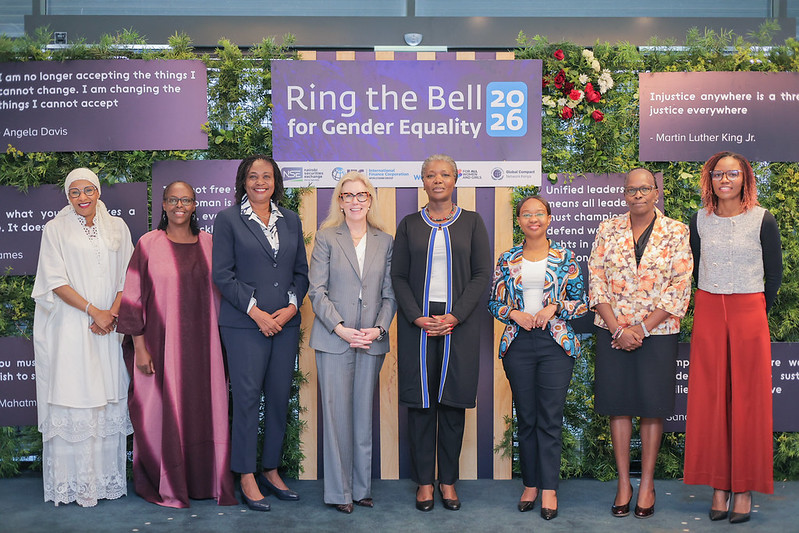
286 years. That is how long it will take to close the global legal gap between women and men at the current pace of reform. It is a number that should make every boardroom uncomfortable. It did not go unnoticed on the morning of 10 March 2026, when Kenya's private sector gathered in Nairobi, to ring the bell for gender equality and reckon with what that number demands.
Ring the Bell for Gender Equality is a global initiative led by stock exchanges worldwide to advance gender equality in the workplace, marketplace, and community. This year's Kenya ceremony was convened by the Nairobi Securities Exchange PLC, Global Compact Network Kenya, the IFC - International Finance Corporation, and UN Women, united under the 2026 global theme: Rights. Justice. Action. For All Women and Girls.
"Gender equality is not a rights issue alone," said Judy Njino, Executive Director of Global Compact Network Kenya. "It is an business imperative." She reminded the room that closing Kenya's gender gaps could boost annual economic growth by 1.5 to 2%. That women earn 17.7% less per hour and 31.3% less per month than men. That 76% of unpaid care work falls on women's shoulders, silently draining the pipeline that companies claim they cannot find. And that Kenya ranks 98th out of 148 economies on the World Economic Forum's Global Gender Gap Report, strong in education, still trailing badly in political empowerment and economic leadership.
The private sector, she argued, does not just respond to culture. It creates it. And the conscience calling leaders forward is now backed by hard economic evidence. Companies that exclude women from leadership, from supply chains, from fair pay, are not just failing a moral test. They are leaving money on the table, and increasingly, losing the confidence of the investors and institutions that move markets.
Kenya's 167 Women's Empowerment Principles signatories, two more joining on the day as Ecobank Kenya Limited and Kenya Bixa Limited signed on, are no longer measured by their endorsement. This year, the first Women's Empowerment Principles Transparency and Accountability Survey launches in Kenya. What gets measured gets managed. What gets reported gets done.

Rita Kavashe, MBS, AoEC - Board Chair and Managing Director at Isuzu East Africa Ltd delivering the keynote address
Inclusion Built the Business
The keynote came from Rita Kavashe, MBS, AoEC, Chair of the Board and Managing Director of Isuzu East Africa Limited, and she spoke from evidence, not theory. When she became the company's first female Managing Director in 2011, market share was modest. Today it sits at 50% in a fiercely competitive sector. Female employees have grown from 6% to 15% in leadership, the supply chain has been deliberately opened to women-owned businesses, and the value of the company has grown in ways that she connected directly to those decisions. Her message was simple: inclusion did not cost the business. It built it.
She was equally direct about what leadership demands in practice. Mentorship, she said, is not enough on its own. Organisations need to deliberately build pipelines, create real access to experience, and link women to opportunity before they are ready rather than waiting until they are perfect. She pointed to organisations like the Women on Boards Network, which identifies, trains, and connects women leaders with governance opportunities, as the kind of infrastructure that accelerates what goodwill alone cannot.
She asked every leader in the room to stop waiting for the system to change and start being the change, specifically asking what they are actively doing to develop the woman beside them, below them, and outside their walls entirely.
High level remarks by the hosting partners
The Market Cannot Afford to Look Away
The Nairobi Securities Exchange brought the capital markets lens. With market capitalisation recently surging past KES 3.41 trillion, Lucy Chepkurui, Head of Talent at the Exchange, asked who is actually driving that growth and who is benefiting from it. Women occupy 36% of board seats in listed companies. Only 12.7% of chief executives are female. That gap, she said, is not a social problem. It is a financial one leaving billions of shillings of potential growth on the table.
Mary Porter Peschka, Division Director for Eastern Africa at the International Finance Corporation, reinforced what is increasingly non-negotiable in global capital: development finance institutions are now asking investee companies for gender data as a condition of doing business. Companies without adequate representation are not just falling short on values. They are losing contracts. The framing has shifted from why gender equality matters to what happens to companies that fail to demonstrate it.
UN Women Kenya Country Representative Antonia N'Gabala-Sodonon called for the shift from general commitments to specific, trackable actions: a target on equal pay, a procurement commitment, a leadership representation number, reported on before the next Ring the Bell ceremony. "When we gather again next year," she said, "we will return not only with renewed commitments, but with clear evidence of progress."
From Commitment to Change - Advancing Rights, Justice and Action for Women and Girls through Business and Capital Markets
The panel brought that accountability to life. Featuring Joshua Musyimi, Programme Specialist at UN Women; Stephen Kimenye , Programme Manager at Global Compact Network Kenya; Ann Nderi, Group Head of Sustainability at NCBA Group; Rose Lumumba, Regional Lead for Corporate Governance in Africa at the International Finance Corporation; and Lilian Gichuru, Legal Manager at Nairobi Securities Exchange, the evidence was concrete: NCBA reached 48% female representation and is now pushing into chief financial officer and chief technology officer roles. The business case, every panelist agreed, is no longer up for debate.
Ann described a journey rather than a destination. NCBA has reached 48% female representation including in senior roles, and is now focused on the next frontier: getting women into chief financial officer and chief technology officer positions. She was candid about what actually drives change inside organisations: leadership alignment at the top, accountability that travels all the way to the frontline, and the copycat effect, where one organisation publicly hitting a milestone prompts others to announce their own targets. She also named what trips companies up: the assumption that good intentions are enough, and the tendency to develop women without simultaneously dismantling the structural barriers that slow them down.
Stephen pointed to what is working across Global Compact Network Kenya's partner network. Absa Bank Kenya grew procurement spend with women-owned businesses from 6% to 18% in 2025 and is targeting 30%. Companies partnering on gender-responsive financial products, leadership pathways, and workplace safety policies are seeing tangible shifts. He was also honest about where the gaps remain: implementation lags behind commitment, and too many organisations are still treating gender equality as a reporting exercise rather than a business transformation.
Rose Lumumba noted that the conversation in boardrooms and investment committees has fundamentally shifted. Gender data is no longer a nice-to-have disclosure. It is a lens through which governance, risk, and long-term performance are being assessed. Lilian Gichuru reinforced how the Exchange itself is using its position to shape the expectations listed companies are held to, moving from encouragement to accountability on diversity and inclusion. The business case, every panelist agreed, is no longer up for debate. What remains is the will to act on it.
Spoken Word artist, Priscar Njeri (Scar Poetry)
Woven throughout the morning, and impossible to ignore, was spoken word artist Priscar Njeri, who opened and closed the formal programme with two original pieces written for this occasion. The room shifted when she spoke. Something in the air changed.
Her first piece, The Grief of Being First, did what data alone cannot. She is the first woman to hold a sports seat at her university, the first in her extended family to hold a degree, the first of many things. And she named the cost of that with devastating honesty: "Every time I am first, this heart breaks a little. Not loudly. Not in a way that ruins the celebration. But quietly. Like something cracking beneath applause." She broke for the women who came before her, just as brilliant, just as capable, denied not by lack but by access. By timing. By a gate welded shut. Progress, she insisted, is not proven by exception. It is proven by repetition. By the day a woman leads and nobody thinks to count it.
Her second piece, The Bell Rings, reframed the very symbol of the morning. Every trading day, a bell opens the market. That day it carried a different obligation: "Do not let this be a promise made in March and softened by June." She asked whether the commitments in that room would survive into quarterly reports, into promotion decisions, into who gets heard the first time. The future, she said, is not asking to be empowered. It is asking to be built correctly.
From Intention to Impact
What happens next is the only part that matters. At Global Compact Network Kenya, we work with hundreds of companies to turn gender equality commitments into everyday practice. Through the Target Gender Equality Accelerator, we give companies structured tools to set and meet targets on women's representation, equal pay and leadership pipelines. Through the Forward Faster Initiative, companies commit to equal representation of women in management and equal pay by 2030. Through the Women's Empowerment Principles framework, and the Transparency and Accountability Survey launching this year, we move the conversation from intention to evidence.
We do this because we believe the private sector is not just a beneficiary of a more equal economy. It is one of the most powerful forces capable of building one. Every hiring decision, every procurement list, every promotion, every policy is a choice. Made differently, consistently and with accountability, those choices compound into the kind of structural change that 286 years of waiting cannot deliver.
We invite every business leader reading this to ask themselves the same question the room was asked on 10 March: what will you do, specifically and measurably, before we gather again?
To join the Women's Empowerment Principles as a signatory, or to engage with Global Compact Network Kenya on gender equality action and all matters sustainability, visit globalcompactkenya.org or contact us at info@globalcompactkenya.org